The Business Case: Numbers That Matter
The shift toward AI-powered document signing is not just a convenience play. It has measurable financial impact.
The global electronic signature market reflects this momentum. One analysis valued the market at USD 7.3 billion in 2024, projecting growth to $76.2 billion by 2033 at a 26.8% CAGR. A separate report from The Insight Partners estimated the electronic signature software market could reach $35.7 billion by 2030 with a 34.2% CAGR.
On the ROI front, Forrester's 2024 Total Economic Impact study found that organizations implementing intelligent contract lifecycle management achieved a 449% return on investment. The same study reported a 90% reduction in time to create new contracts and an 80% decrease in labor costs for researching contract terms.
For a practical way to forecast savings and efficiency gains from automation in your office, check the Document Automation ROI Calculator.
These figures reflect what HR teams report on the ground. The time savings are measurable. But practitioners often point to something harder to quantify: the reduction in cognitive load - no longer mentally tracking who signed what, which form version is current, which new hire is still missing a document. When the system handles that, HR professionals describe it as getting a second brain.
What AI-Powered Signing Looks Like in Practice
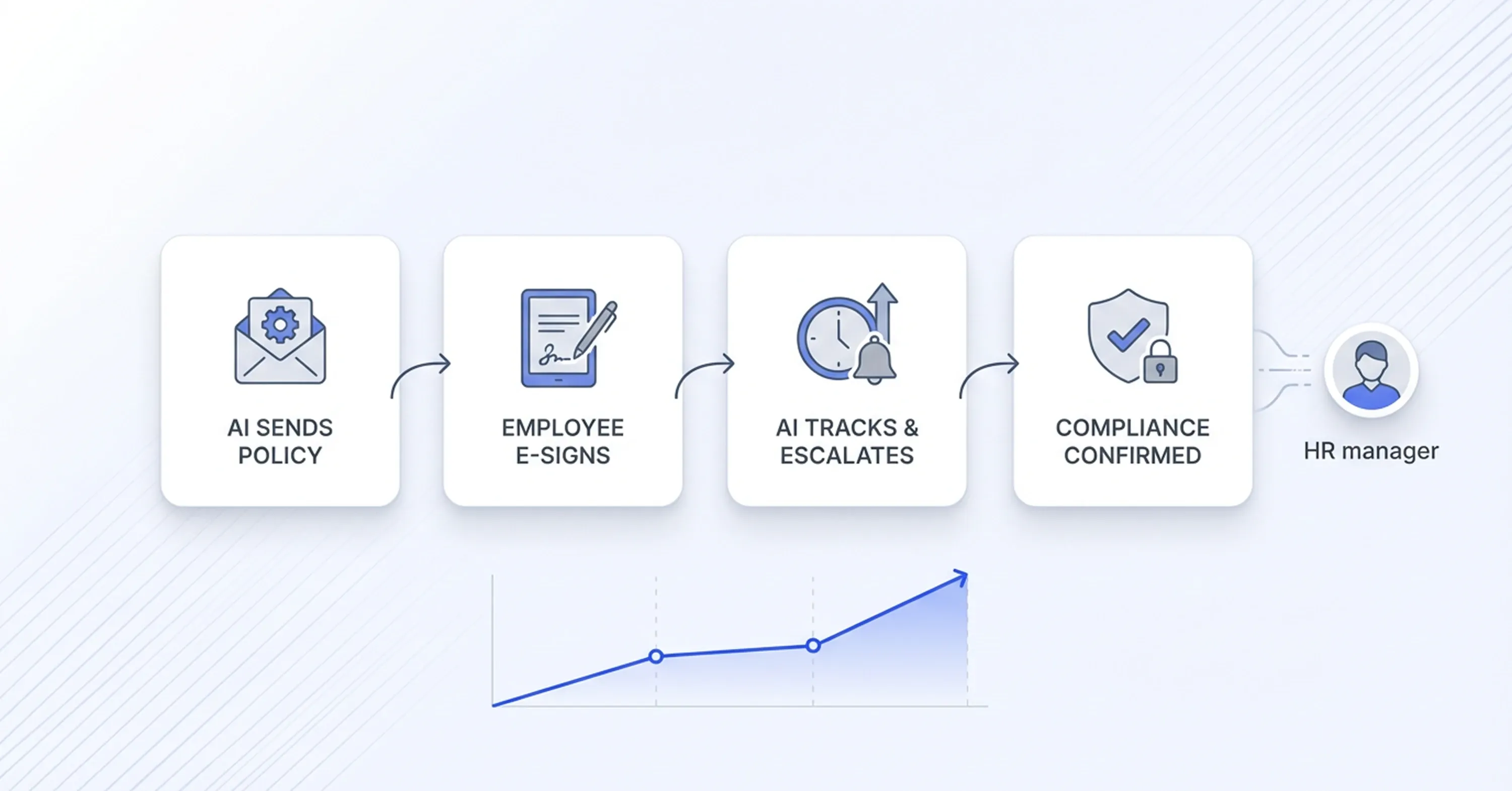
To make this concrete, here is what a typical HR workflow looks like with AI handling the document signing process:
-
A new hire accepts an offer, triggering automatic assembly of their onboarding packet
-
AI selects the correct forms based on role, location, and employment type
-
Documents are sent for digital signature with pre-filled employee data
-
The employee reviews and signs from any device, with real-time field validation
-
Completed documents are automatically filed, indexed, and linked to the employee record
-
HR receives a dashboard summary showing completion status across all active onboarding cases
Platforms like Agrello are built around this kind of intelligent workflow, combining digital signature capabilities with AI-driven document handling that reduces the manual burden on HR teams. For more on how teams manage large-scale document workflows using AI, see How can I bulk sign multiple documents with AI?.
Meanwhile, a Gartner survey found that 45% of managers report AI has lived up to their expectations in improving their teams' work. As AI in HR automation e-signature workflows matures, that number is likely to grow.
What AI Actually Improves in HR Document Signing
AI improves HR document signing processes by automating document assembly, routing, validation, tracking, and filing. It reduces manual effort for HR teams, cuts errors in payroll and compliance forms, and creates a faster, smoother signing experience for employees. The technology works best when integrated into existing HR systems and applied to high-volume, repetitive document workflows like onboarding, policy acknowledgments, and benefits enrollment.
Conclusion
AI is not replacing HR teams. It is redesigning how HR operations work at scale. By removing manual routing, follow-ups, and error-prone data entry, AI turns document signing from a bottleneck into a structured, predictable workflow.
The impact goes beyond efficiency. Onboarding becomes faster and more consistent. Payroll errors drop before they happen. Compliance is no longer reactive, but built into the process itself. Most importantly, HR teams stop operating as coordinators of paperwork and return to what actually drives value: hiring, retention, and employee experience.
For companies growing headcount and complexity, AI-powered document signing is not an optimization. It is operational infrastructure. The difference is simple: without it, HR teams chase documents. With it, the system runs itself.