Security and compliance in batch processing
When you automate a legal process, security is paramount. A mistake in a manual process affects one document; a mistake in a bulk process affects hundreds. Therefore, the security protocols of your chosen solution must be robust. You need to ensure that every generated document has a unique digital fingerprint and an audit trail that stands up in court.
Bulk signing does not mean bypassing security steps. In fact, it often strengthens them. Automated systems generate detailed logs of exactly when a document was created, sent, viewed, and signed. This is often more reliable than manual filing systems where papers can go missing.
-
Audit trails: Ensure your provider creates a separate certificate of completion for each individual envelope in the batch.
-
Identity verification: For high-value contracts, consider enabling two-factor authentication (2FA) via SMS for signers.
-
Data encryption: Verify that the data transfer from your spreadsheet to the cloud platform is encrypted.
-
Access control: Limit who in your organization has the permission to initiate bulk signing campaigns to prevent unauthorized mass agreements.
These security measures translate into real business value. The market acknowledges this, with projections showing the e-signature market to grow from USD 13.4 billion in 2025 to USD 70.2 billion by 2030. This massive investment in the sector is largely driven by the improved security and compliance capabilities that come with premium e-signature tools.
For essential security and compliance concepts, explore Electronic Signature Definition: Meaning, Legality & Use Cases.
Furthermore, speed does not just mean convenience; it means better business outcomes. DocuSign data shows 79% of e-signature transactions on its platform were completed within 24 hours. By combining security with speed, you ensure that your critical business documents are finalized quickly and safely.
Now that we understand the process and the safety measures, let's look at where this technology delivers the most value in a typical mid-sized company.
Real-world use cases for AI bulk signing
The theoretical benefits of bulk digital signing are clear, but how does it look in practice? For a mid-market company with 50 to 300 employees, the applications are often found in departments that handle high volumes of standardized paperwork. HR and Sales Operations are the usual suspects, but procurement and compliance teams also benefit significantly.
HR onboarding and policy updates
When a company updates its employee handbook or requires a new confidentiality agreement from all staff, HR managers face a nightmare of logistics. Sending an email with an attachment and asking employees to "print, sign, and scan" results in low compliance and high frustration. With bulk signing, HR can send a personalized copy of the new policy to every employee instantly. Dashboard analytics allow the HR team to see exactly who has opened the document and who needs a reminder. This approach drastically improves compliance rates.
Learn how HR teams are leveraging smart contracts and automation in From Paperwork to Smart Contracts – How AI and RPA Transform HR Contract Management.
Sales contract renewals
For businesses with subscription models, end-of-year renewals can be overwhelming. Sales Ops teams can automate the generation of renewal contracts where the only changing variables are the customer name and the pricing tier. By automating this, the sales team can focus on upselling rather than paperwork. Statistics support this impact, as companies report an average 75% improvement in contract turnaround times after adopting e-signature solutions.
Vendor agreements
Operations managers often need to update terms with dozens of suppliers simultaneously. Bulk signing allows them to execute these updates in one go, ensuring that the supply chain remains compliant without stalling operations. Additionally, this digital approach creates tangible savings on logistics, as adopting e-signatures can reduce traditional shipping/courier costs by up to 80%.
Transitioning to these automated workflows frees up your team to focus on strategy rather than administration. It solves the problem of scale, allowing you to grow your headcount or customer base without linearly growing your administrative burden.
What is AI bulk signing?
AI bulk signing is the automated process of digitally signing and distributing large volumes of documents simultaneously. It utilizes artificial intelligence to merge structured data (such as names and dates) into standardized document templates, apply the sender's digital signature to all generated files instantly, and dispatch them to individual recipients. This technology eliminates the manual repetition of preparing and sending contracts one by one, ensuring consistency, speed, and compliance across hundreds or thousands of agreements.
Conclusion
Bulk digital signing transforms a tedious administrative burden into a strategic advantage. By leveraging AI to handle the repetitive work of document preparation and signature application, you can process hundreds of agreements in the time it used to take to handle one. The market is clearly moving in this direction, with about 95% of businesses either using or planning to implement e-signature technology.
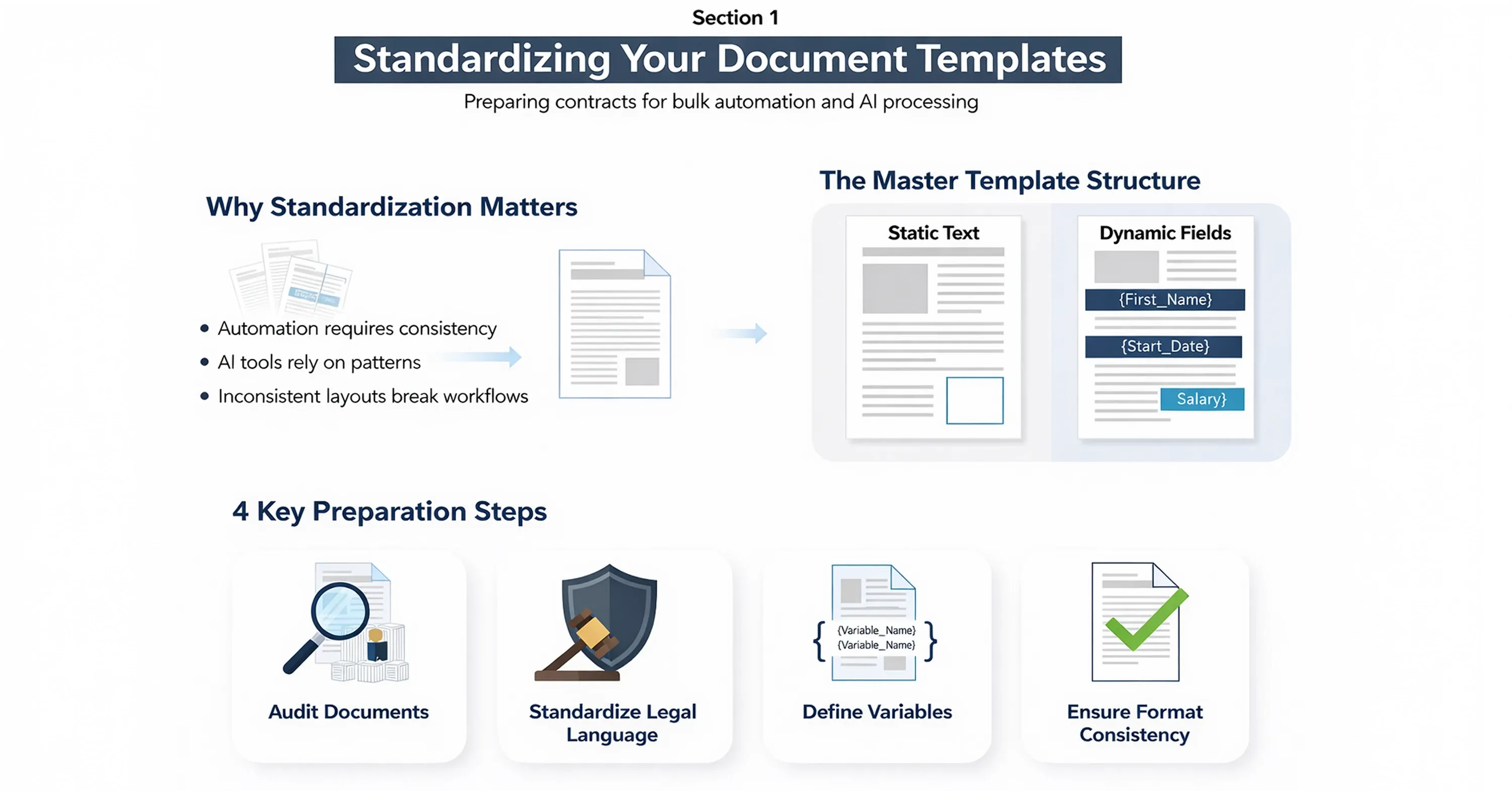
Whether you are an HR manager streamlining onboarding or a Sales Director accelerating renewals, the key to success lies in preparation. Standardize your templates, clean your data, and choose a platform that balances power with usability. When executed correctly, bulk signing delivers speed, accuracy, and significant cost savings, allowing your team to focus on the human relationships behind the contracts rather than the paperwork itself.